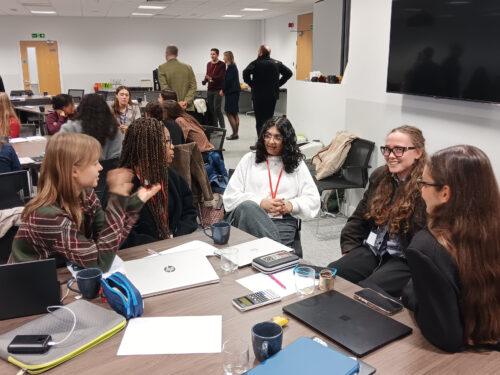
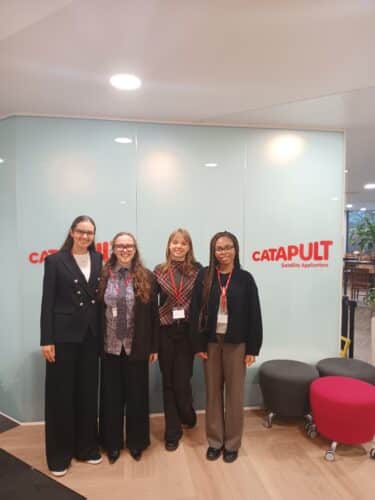
As part of the GDST Space elective, Senior School pupils take several trips to meet people in the industry and to connect with other GDST schools throughout the academic year. On this occasion, the group visited the Harwell Space Centre in Didcot.
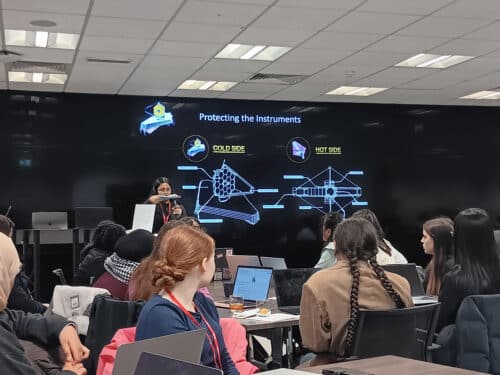
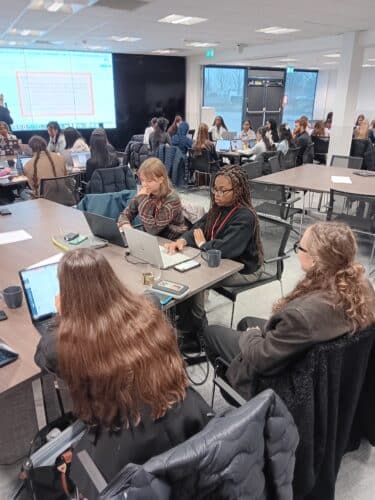
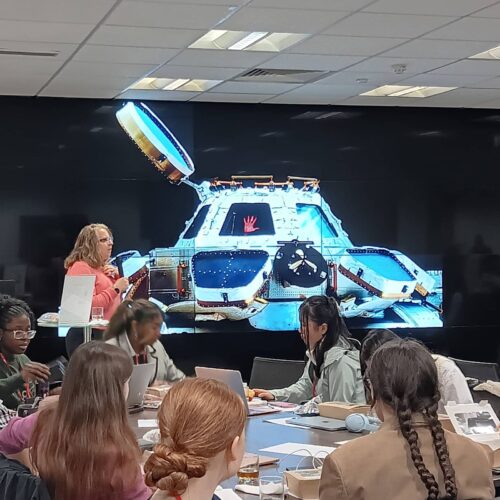 In the morning, they attended a presentation on the composition of the JWST, expanding on what they had previously learned about the MIRI instrument. They then took part in a coding exercise that continued the work from Module 1. Their task was to derive an equation linking the day of the year to the angle at which the JWST must point away from Earth to keep its instruments cool, and then write code to generate a graph of this angle across the year using a 2D array.
Afterwards, the pupils listened to people working in the space and satellite industries. They learned about the wide range of roles available and the flexibility within the field. For example, Fernanda from Oxford Dynamics worked in five different areas before moving into machine learning, while Imogen studied natural sciences before specialising in astrophysics and later joining Space Partnership, where she combines science, politics and industry.
One particularly memorable talk was from Libby Jackson, who described her career path and the challenges she faced. Determined from a young age to become a mission controller, she contacted NASA asking to shadow someone—and was unexpectedly accepted. At 17, she travelled to Florida for two weeks to do so. Throughout university she volunteered extensively to build experience, eventually becoming a flight controller for the Columbus Module in 2010. She now serves as the first ‘Head of Space’ at the Science Museum, helping preserve the history of women in space.
To end the day, the pupils formed groups with another GDST school and visited different departments at Harwell. Their group heard from a member of Oxford Dynamics, who explained how the robotics and machine learning teams train satellites to identify nearby objects in space—an especially fascinating insight into real-world applications of the technology.
“It was an incredible experience, as we got to learn so much about the industry and the people working in it as well.”Leni, Year 12 pupil